

A fender bender car accident can look minor in terms of vehicle damage, but your body may tell a different story over the next several hours or days. Even if the cars show only scrapes or dents, these lesser impacts can still cause hidden injuries like whiplash, soft tissue strains, or concussions that aren’t always felt right away. If you were injured in a low-speed fender bender, the steps you take right away can protect both your health and your ability to make a fair insurance claim later.
At Braff Law Car Accident Personal Injury Lawyers, we believe that victims of a fender bender accident in California deserve justice for their pain and suffering. The following is an easy and practical guide you can follow, even if you feel shaken up and unsure what to do next. Braff Law Firm’s knowledgeable car accident lawyers are available to discuss your fender bender accident anytime 24/7. We offer a “no win, no fee” contingency fee and offer a FREE initial consultation to all fender bender victims in California.
How Do Fender Benders Happen?
Fender benders are common minor accidents that usually happen at low speeds. They are mainly “property damage only” accidents to the victim’s car, but they can still cause injury and stress. Understanding how these incidents occur can help drivers stay alert and avoid them. Common causes include:
- Distracted driving, such as texting or eating behind the wheel
- Following too closely (tailgating), leaving insufficient stopping distance
- Sudden stops by the car ahead, catching the following driver off guard
- Failing to yield at intersections or during lane changes
- Misjudging parking maneuvers or backing out without proper visibility
- Poor weather conditions reducing traction and reaction times
Staying focused and maintaining safe distances can significantly reduce your risk of a fender bender.
How Many Fenders Benders Occur in California Every Year?
There are more car accidents in California than anywhere else in America every year, which makes it no surprise our state also holds the number one ranking for fender bender accidents:
- There are approx. 400,000 car accidents in California every year
- Approx 280,000 (or 70%) are considered “fender benders”
- The 25 to 34 age demographic is responsible for the largest portion of fender benders
- Nearly 175,000 car accidents every year cause injury or fatality

What Injuries Do Fender Bender Accidents Cause?
Small-scale property damage does not always mean low injury risk. Some of the most common fender bender injuries include:
- Whiplash and neck strain
- Shoulder injuries (including rotator cuff strain)
- Back pain, including disc issues that can appear later
- Concussion or mild TBI symptoms (headache, light sensitivity, nausea, brain fog)
- Wrist and hand injuries from bracing on the steering wheel
- Knee injuries from dashboard impact
- Emotional distress, driving anxiety, and sleep disruption
If you experience delayed symptoms, document them and get checked. Delays are common, but long gaps in care can give insurers an argument to claim your injuries were not serious enough.
Are You Eligible for Compensation From a Fender Bender?
To determine if you’re eligible to claim compensation after a fender bender in California, start by assessing whether you suffered any injuries, even minor ones. Eligibility typically requires that another party was at fault and their negligence caused your injuries or property loss. If you miss work or incur expenses due to the accident, you may qualify for additional compensation covering those losses.
What Types of Compensation Can You Get After a Fender Bender?
A large portion of fender bender accidents are considered “property damage only”, where there are no discernible injuries to the accident victim. Still, every car accident claim involving a fender bender is different, and a typical California injury claim may include:
- Medical bills (ER, urgent care, imaging, physical therapy, chiropractic care, medications, follow-ups)
- Lost income (missed work, reduced hours, used sick time, potential diminished earning capacity)
- Pain and suffering (physical pain, limitations, emotional distress, loss of enjoyment)
- Property losses (repair costs, towing, storage, rental car, and sometimes diminished value when supported)
The key is linking these losses clearly to the fender bender collision with records, receipts, and consistent medical documentation.
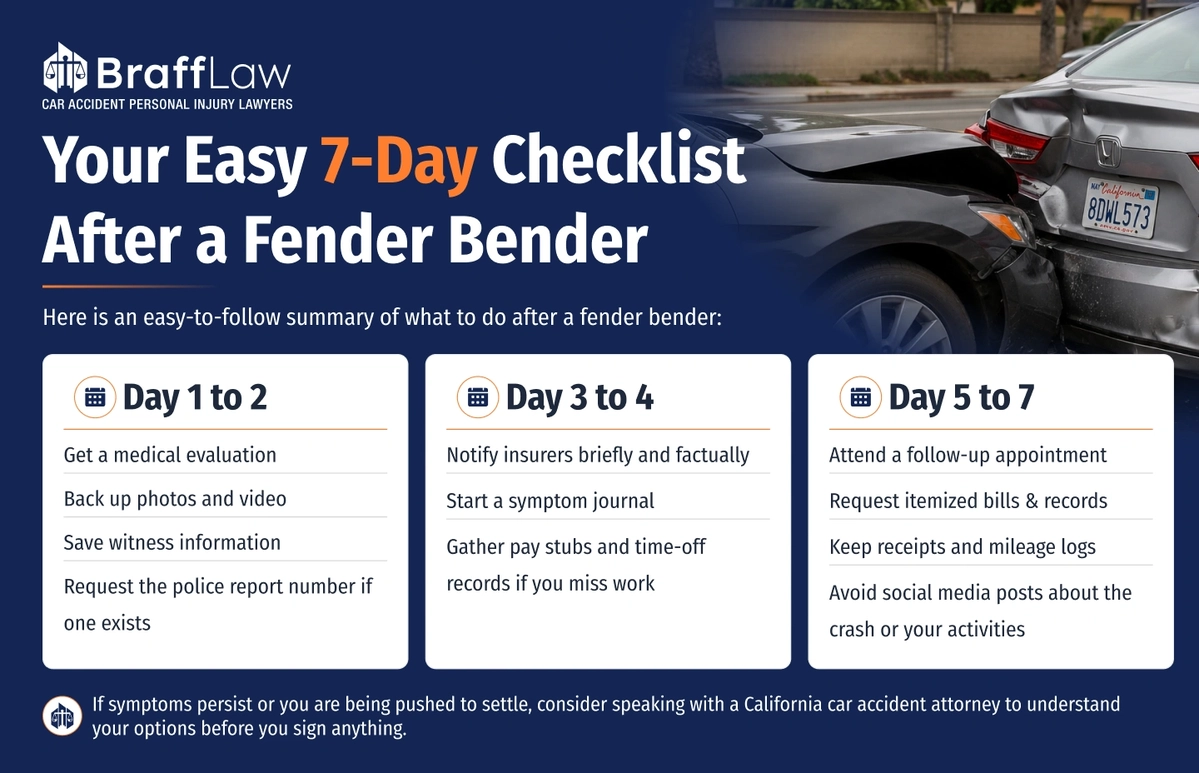
What To Do After a Fender Bender
1. Make sure you’re safe (don’t make your injuries worse)
Start with safety, not paperwork. If the vehicles can be moved, pull to a safe spot out of traffic. If they cannot be moved, turn on hazard lights, stay belted if it is safer than stepping into traffic, and get to a protected area when you can do so safely.
Call 911 if any of the following are true:
- Anyone is hurt, even “a little”
- Traffic is blocked or there is a risk of a secondary crash
- You suspect DUI or drug impairment
- You feel unsafe due to road conditions, aggression, or location
Accept medical help at the scene if it is offered. Soft-tissue injuries, concussion symptoms, and back issues can be delayed, and adrenaline can mask pain. Keep your comments calm and simple, and avoid making decisions based on how you feel in the first five minutes.
2. Document the scene like you’ll need it later (you probably will)
Even in a low-speed collision, documentation often becomes the difference between a smooth claim and a denied one. Take photos and video that show both the big picture and the details:
- Wide shots of vehicle positions, lanes, and intersection layout
- Close-ups of damage on all vehicles
- License plates and VIN (if accessible)
- Skid marks, debris, and road surface conditions
- Weather, lighting, and visibility conditions
- Traffic signs, signals, and nearby landmarks
Record a quick voice note while details are fresh: time, exact location, direction of travel, what you remember happening, and how you feel physically. If there are witnesses, get their name, number, and a short statement before they leave.
If you have dashcam footage, save it immediately and back it up. Some systems overwrite recordings quickly.
3. Exchange the right information, then stop talking
Be polite, but treat the scene like a fact-gathering moment, not a discussion. Be sure to collect:
- Driver name, address, phone number
- Driver’s license number
- License plate number
- Insurance company and policy number
- Vehicle make, model, and color
Avoid apologizing, guessing, or saying anything that sounds like fault, even if you are trying to be courteous. Statements like “I didn’t see you” or “I’m fine” can be used against you later. Do not argue at the scene. Get the information you need, then focus on medical care.
4. Get medical care quickly (even if symptoms show up tomorrow)
If you hit your head, feel dizzy, nauseated, numb, or have severe or worsening pain, go to urgent care or the ER right away. If symptoms feel mild, it is still smart to get evaluated as soon as you can. Many common crash injuries do not fully show up until the next day.
Follow up with your primary doctor and ask for:
- A written treatment plan
- Work restrictions if needed
- Referrals for imaging or specialists if appropriate
Keep copies of discharge papers, imaging results, prescriptions, and referrals. Also track symptoms daily. A short symptom journal can be powerful when injuries evolve over time.
Common entries include neck stiffness, headaches, sleep disruption, anxiety, brain fog, radiating pain, and reduced range of motion.
5. File a police report when appropriate (keep the report number)
In many California crashes, a report helps establish baseline facts, especially if injuries develop after you leave the scene. If officers do not respond, ask whether you can file an incident report online or at a local station (availability depends on the city and the situation). Write down the report number and the responding agency, then request a copy when it becomes available.
6. Notify insurance, but BE CAREFUL with recorded statements
Report the crash promptly to your insurer, but keep it brief and factual. Provide location, time, vehicles involved, and the basics of what happened. If you are unsure about injuries, it is okay to say you are seeking medical evaluation. Be cautious about:
- Recorded statements before you understand your injuries and have all facts
- Speculating about speed, distance, or fault
- Signing broad medical authorizations that allow access to your entire medical history
If the other insurer calls quickly with a friendly tone and a fast offer, be careful. Early settlement offers often arrive before treatment is complete, and once you settle, you typically cannot reopen the claim if symptoms worsen.
How a Car Accident Lawyer Helps Fender Bender Victims
The best personal injury lawyers handling fender bender car accident claims do more than file paperwork. In a fender bender case, the biggest challenge is often proving that a low-speed crash caused real injuries, especially when symptoms are delayed.
At Braff Law Firm, our expert California car accident lawyers help fender bender victims by:
- Identifying all liable parties (other driver, employer vehicle, rideshare, and in rare cases roadway issues)
- Preserving evidence (photos, video, witnesses, vehicle damage documentation, medical timelines)
- Handling insurer communications so you do not get trapped by harmful statements
- Building a clear narrative connecting the crash to your injuries using medical records and consistent documentation.
The preceding is especially important when the insurer leans on the common argument that “low-speed means no injury.” At Braff Law Firm, our California car accident lawyers stand up for ALL car accident victims, from major auto collisions to smaller-scale fender benders. Give our supportive California personal injury lawyers a call today at (213) 370-2483 or find us online with an easy search for “car accident lawyer near me”.